Building an AI & Crowdsourced Food Finder when SNAP is Threatened
When a major shift in public policy (the loss of SNAP benefits) created an information crisis, traditional food assistance tools failed. I noticed an underlying problem—a "data footprint" of expired programs that made search results useless—and tried to build a solution.
The Community Food Finder is a serverless web app that bypasses this "data clutter" by combining a real-time AI search with a crowdsourced, neighbor-to-neighbor pledge system. It's a low-cost, high-impact tool that serves as a case study in modern, community-driven problem-solving.
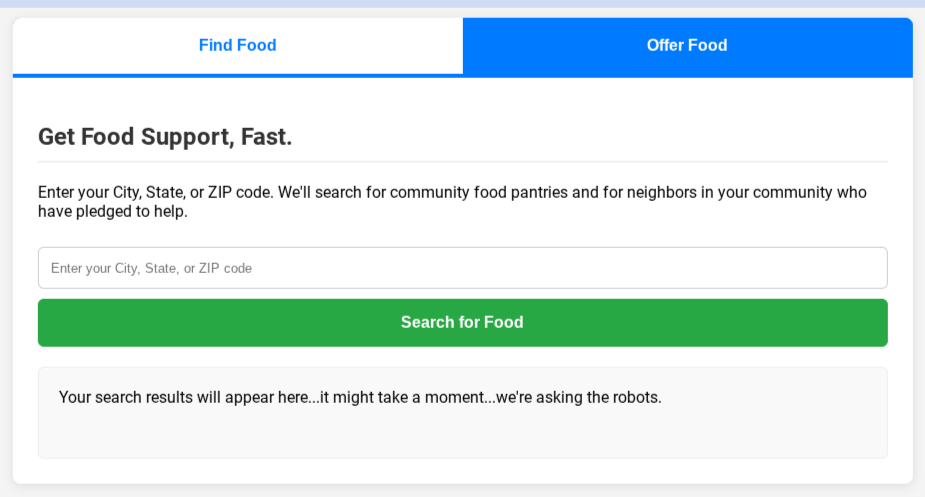
Screenshot of the Food Finder App.
Users can input their address for:
an AI-driven (Gemini) list of current, actionable resources, with access instructions and residency limitations;
Followed by a list of neighbors who have offered support using the “Offer Food” tab in the app.
The Challenge: The "Ghost in the Room"
As a community development professional, I've seen firsthand how food insecurity strains a community. But recently, a major policy change—the widespread reduction of SNAP benefits—created a new, hidden crisis.
It wasn't just that families had less money for food. Simultaneously, the entire information system for finding help broke down.
Think about it: for years, the internet has been saturated with information about SNAP programs. Every program has pages and pages of data verbiage about how to sign up, how it works, etc. Every programmatic partner has posted how to get benefits when SNAP is providing and functioning. When those programs vanished, the links, articles, and resource pages didn't. They became "data ghosts."
I call this the "SNAP Footprint."
Suddenly, a person in need searching "food assistance in my town" was met with a useless sea of links to expired programs, broken applications, and old phone numbers. The traditional "food pantry finder" apps, often relying on static, human-updated lists, couldn't keep up. The "elephant in the room" (SNAP) had left, but its footprint was so large it was impossible to see anything else.
The Diagnosis: A Two-Part Problem
The problem wasn't just a lack of food; it was a lack of connection. People didn’t know where to turn. Meanwhile, I see friends and neighbors posting all over Facebook “If you’re in trouble, I’ll make sure you’re fed.” But I don’t know that Facebook is the way to connect those well-intended offers with people in need.
The Public Data Problem: How do you find the real, currently-operating food pantries, soup kitchens, and church programs buried under the noise of the "SNAP Footprint"?
The Private Goodwill Problem: How do you tap into the informal, neighbor-to-neighbor goodwill that exists in every community but isn't listed in any directory?
Building a Hybrid Search Using AI to get past the Ghost Footprint & Connect Neighbor Offers
My solution is the Community Food Finder, a serverless web app I designed and built to attack both problems simultaneously.
It's a hybrid, dual-function tool that provides a "System + Neighbors" safety net.
The System (AI-Powered Search): To bypass the "data ghosts," I turned to Generative AI. Instead of a static database, the app's "Find Food" tab performs a dynamic, real-time search for public resources. I engineered a complex "system prompt" that commands the AI to act as a structured data service. It hunts for active pantries, banks, and church programs, demanding current hours, addresses, and requirements. This effectively filters out the expired "SNAP Footprint" in real-time.
The Neighbors (Crowdsourced Pledge System): To tap into the informal safety net, I built a "Neighbor Pledge" system. The "Offer Food" tab links to a simple Google Form where individuals can "raise their hand" and pledge to provide food assistance. Their contact info is securely stored in a Google Sheet (acting as a simple database) and is only shown to a user who searches for that volunteer's specific ZIP code. This creates a formal, discoverable mechanism for the informal, hyper-local goodwill that is often a community's strongest asset.
The Technology: Agile, Frugal, and Effective
The entire application is a model of efficient, agile development. It's built on the Google Apps Script platform, which means it is:
Serverless: It runs on Google's infrastructure, requiring no servers to manage.
Scalable: It can handle one user or one million users.
Zero-Cost: It has virtually zero hosting costs, making it a sustainable public utility, not a financial burden.
This architecture demonstrates a key principle of my work: you don't need a multi-million dollar grant or a five-year planning process to build an effective public tool. You need the right diagnosis and a practical, scalable design.
The Impact: A Tool for Solvers
The Community Food Finder is more than a public utility; it's a new model. It proves that we can respond to rapid policy shifts with agile, intelligent, and community-driven solutions.
It serves the user by providing a single, reliable-as-possible source for both institutional and informal help.
It serves the community by creating a powerful network effect—the more people who sign up to offer help, the more functional and powerful the tool becomes.
This project is a perfect example of my professional approach: diagnose the systemic failure, not just the symptom, and build a practical tool to fix it. Usually, I’m writing policy or building programs. But this time it was an app.
If your community or organization is facing a complex challenge that old solutions can't solve, let’s connect.
March 2026 Update: The SNAP Food Finder Tool has been donated to a regional food nonprofit for integration into their programming and dissemination to partners. I’m delighted to see that it will be kept available and accessible where useful. —Shane